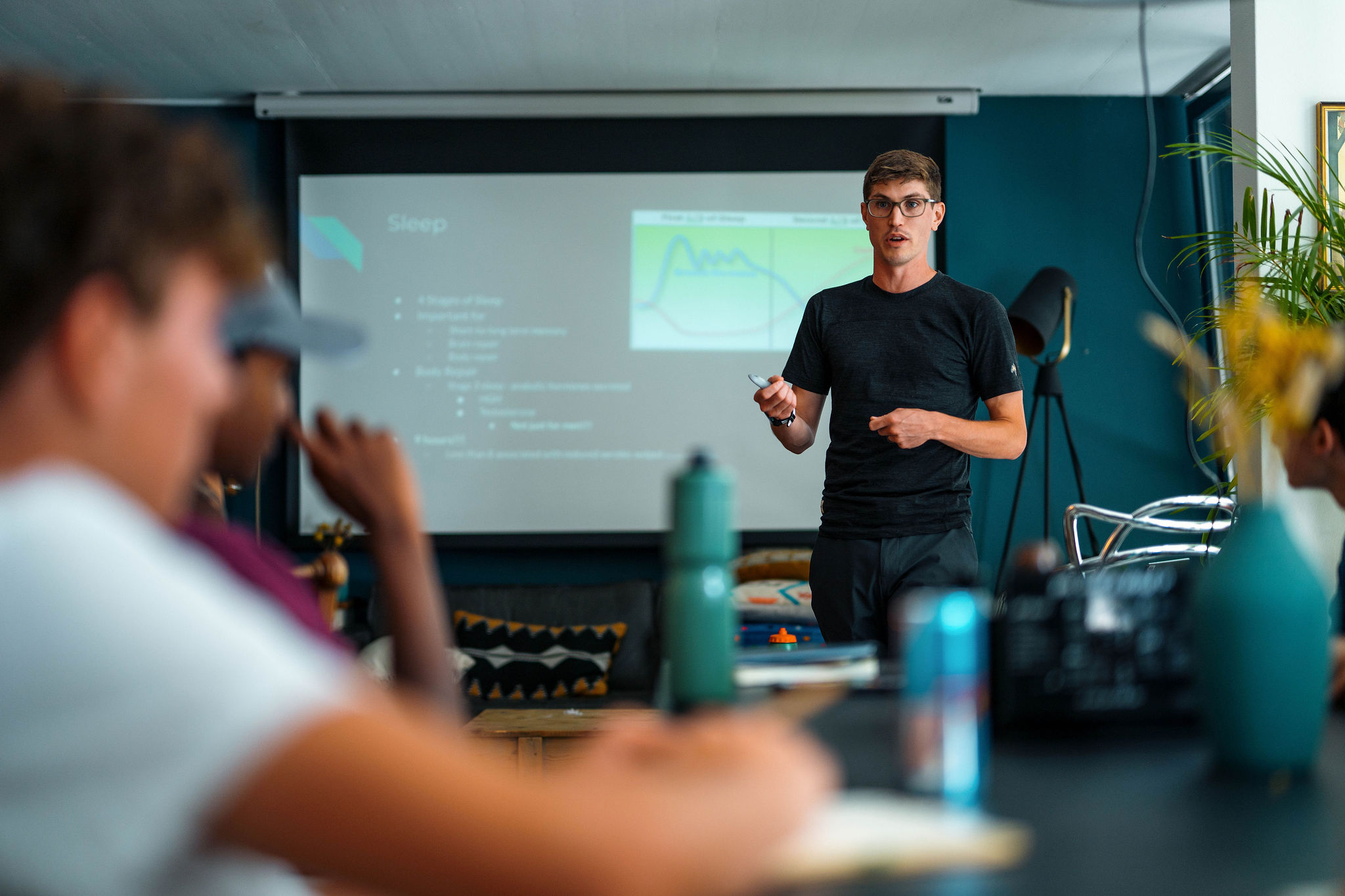
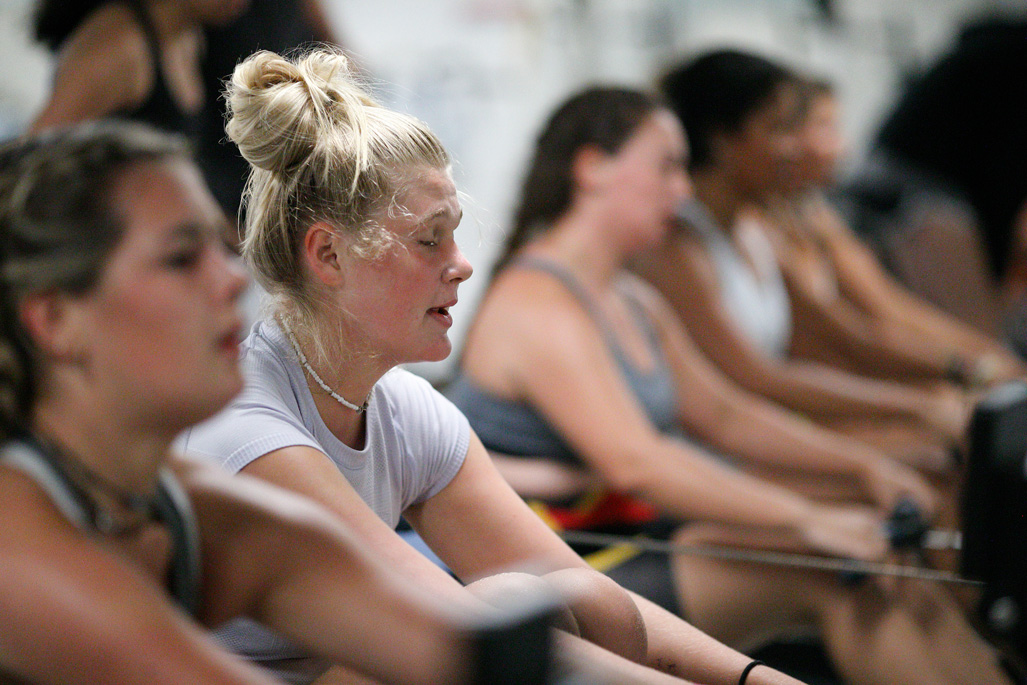
Ask a college rower what surprised them about freshman fall and the answers converge. It was not any single practice. Juniors from good programs have done hard practices. It was the accumulation: the fourth training day in a row at a volume they used to hit twice a week, on six and a half hours of sleep, with a problem set due and no parent managing the groceries. The jump from junior to collegiate rowing is the largest sustained increase in training load most rowers will ever experience, and it arrives bundled with every other adjustment of leaving home. This article lays out what the evidence says about that jump, why it carries real injury risk, and what preparation actually helps.
How much bigger is college rowing training than high school?
For most athletes, structured training time roughly doubles. The honest answer depends on where you start. World Rowing's development guidelines put well-trained under-18 rowers at 8 to 12 hours per week, and most US high school clubs practice four to six days a week. NCAA rules cap countable athletically related activities at 20 hours per week in season with one required day off, and the countable number excludes travel, treatment, and the "voluntary" sessions that are voluntary in name. Descriptions of D1 weeks converge on six days of rowing plus additional erg and strength work, with the strongest programs logging 12 to 15 hours of steady state alone before lifting is counted.
The NCAA's own athlete surveys add texture worth knowing. In the most recent GOALS study, Division I women's rowers reported a median of 26 hours per week on athletics and 43 on academics, for 69 combined hours. The academic figure is the heaviest of any D1 women's sport. Two honest notes apply to those figures. The athletics number bundles practice with meetings, treatment, and team functions rather than measuring pure training. It has also declined since 2019, the largest drop of any D1 women's sport. College rowing is not getting more time-consuming. It is simply a great deal more than almost any junior program asks, delivered with a consistency most freshmen have never sustained.
The consistency is the part athletes underestimate. A junior schedule flexes around school events and family life. A collegiate schedule does not. The five a.m. alarm happens whether Tuesday's session went well or badly, and the adaptation demanded is less about surviving any single workout than about absorbing the same demand again fourteen hours later.
Why does the training jump carry injury risk?
Because rowing's most common injuries track training volume, and the freshman transition is the largest volume increase in the sport. The epidemiology is well established: low back pain affects roughly a third to a half of rowers over a twelve-month training year and causes more missed training than any other complaint, and research by Teitz and colleagues on more than 1,600 intercollegiate rowers linked back pain risk to long ergometer sessions and heavy training exposure. Rib stress injuries occur in roughly nine percent of rowers and typically cost six to eight weeks. In one prospective national-squad cohort, ergometer training load showed the strongest association with injury risk. The researchers cautioned that volume is one factor among several. One prospective study followed 137 first-year university rowers through a season and found that 80 percent sustained at least one injury. The result was published as a conference abstract in BMC Sports Science, Medicine and Rehabilitation.
Two honest boundaries apply to this evidence. First, the research does not show that new collegiate rowers get hurt more than veterans; what it shows is that injury follows volume and ergometer exposure, which are precisely what spikes in freshman fall. Second, the popular frameworks for quantifying safe load increases are genuinely contested in the sports science literature. Prominent researchers dispute the thresholds of both the acute-to-chronic workload ratio and the ten percent rule. What survives the debate is the directional point: large sudden jumps are associated with injury, with increases above roughly thirty percent flagged in studies of novice endurance athletes. The practical protection is arriving at school already adapted to something close to collegiate volume rather than absorbing the whole jump in September.
What makes freshman year harder than the training alone?
Three things compound the meters, and the evidence on each is specific.
Sleep goes first. NCAA athletes report averaging six hours and 48 minutes on a typical in-season weeknight, and women's rowers sit near the bottom of D1 sports. The American Academy of Sleep Medicine recommends eight to ten hours for adolescents, and the gap is expensive: research by Milewski and colleagues found adolescent athletes sleeping under eight hours were 1.7 times more likely to be injured. A freshman rower who protects sleep is doing more measurable injury prevention than most training choices can offer.
Fueling often fails to scale. When training volume jumps and eating stays at high school levels, energy availability drops. The IOC's consensus on relative energy deficiency links that state to impaired bone health and elevated stress-injury risk. That risk matters more in a sport with rib stress injury in its profile. The guidance here is simple and general: eating must grow with training, and an athlete who struggles with that adjustment should work with the qualified support staff every collegiate program provides.
The psychology also inverts. Most recruits arrive from the top of a junior team and start at the bottom of a college roster. On the women's side that roster can now carry up to 68 funded athletes under the current NCAA rules. Research on student-athlete identity cuts both ways: belonging to a team aids first-year adjustment, while an identity built entirely on being the fastest junior in the room adjusts poorly. For a while, you will not be. The athletes who handle this are the ones whose relationship with the sport runs deeper than their ranking in it.
What do college coaches say about first-year rowers?
The coaches who develop first-year athletes talk far less about fitness than families expect. In row2k's series on novice rowing, Cornell's Todd Kennett measured success by whether a walk-on contributes meaningfully "by their junior year," a three-year horizon. Adrian's Bart Thompson defined a successful first year by whether an athlete finishes it with the technique, work ethic, and values to integrate into the varsity. Fitness was one item on his list. A Coast Guard Academy coach described counseling experienced incoming freshmen toward patience, because the hardest thing to do in September is slow down. Stetson's Katie Thurstin gave the bluntest version of the goal: they come back their sophomore year.
Read together, these answers say that freshman year is an adaptation year, and programs plan for it. The athletes who struggle most are often the ones racing an imagined timeline in which they must prove themselves by October. That mindset is exactly what turns a volume jump into an injury.
How should you prepare the summer before college rowing?
The evidence supports a specific and mostly unglamorous list.
Build the aerobic base at low intensity. The best junior development data available, a season-long study of world-class German junior rowers, found they performed 95 percent of their rowing volume at low intensity, below roughly 2 millimoles of blood lactate. Volume tolerance is built with easy meters, and the summer training framework shows how to structure them.
Ramp gradually toward collegiate volume. Get your weekly hours moving toward the collegiate range across the whole summer rather than in a heroic final month, avoiding large week-to-week spikes. Arriving already adapted to ten to twelve honest hours makes September an increase instead of a doubling.
Keep the strength foundation at two or three sessions per week. The international youth consensus establishes supervised resistance training as safe and beneficial, and our strength training guide covers what a rower's sessions should hold. Legs and trunk carry the injury-prevention logic in a sport whose costliest injuries load the ribs and lower back.
Build the sleep habit now. An eight to ten hour pattern established in August survives September better than one improvised during it. If your school starts preseason in a hot climate, know that heat acclimatization takes seven to fourteen days of progressive exposure per the National Athletic Trainers' Association, and plan your arrival training accordingly.
Learn to monitor yourself. A systematic review by Saw and colleagues in the British Journal of Sports Medicine found that simple subjective self-reports of mood, soreness, sleep, and perceived effort outperform objective measures at detecting how an athlete is absorbing training load. A daily two-minute log is the cheapest early-warning system in sports science, and it is also the foundation of coaching yourself: the athlete who can observe their own state, connect it to their training, and adjust is the one who catches a bad week before it becomes a rib.
That last skill is the honest summary of the whole transition. The freshman year rewards athletes who can run their own recovery, fueling, and attention without a parent or a junior coach watching. Those capacities can be built deliberately before arrival. It is why our four-week Rowing Leadership Program in New Zealand is built as a transition block for incoming freshmen: collegiate-rhythm training in Dunedin at a 1:3 staff-to-athlete ratio, with the self-coaching and self-regulation work done under real load. We make no promises about what any program does for a boat ranking or an erg score. What preparation can honestly offer is a freshman fall spent adapting to college rowing instead of being ambushed by it, and the evidence above is the map. The 2K that got you recruited opened the door. The first year is where you learn to live inside the sport, and it goes better for athletes who arrive already knowing how to manage themselves.