
Our pricing reflects the value of early planning. Current rates and availability are listed on each program page. Optional cancel-for-any-reason insurance allows cancellation up to two days before camp.

A Four-Week Opportunity for Thoughtful, Serious Athletes
Combine two of our European cross country camps into a four-week development program. Three pairings are available:
- Swiss Cross Country Challenge, Session 1 (June 25 to July 6) into the Norwegian Cross Country Challenge (July 7 to July 18)
- Norwegian Cross Country Challenge (July 7 to July 18) into the Cross Country Leadership Program (July 19 to July 30)
- Swiss Cross Country Challenge, Session 2 (July 7 to July 18) into the Cross Country Leadership Program (July 19 to July 30)
Most cross country camps run five to seven days. A few can be stacked into two or three weeks at the same site with the same curriculum repeated. We found nothing else in the sport built the way this is: four weeks, two countries, two kinds of ground, and one continuous developmental thread carried by staff who know your athlete from the first week to the last.
Four weeks changes what a summer can do. Instead of a week that interrupts your training, you get a block of work that becomes your training, in terrain you cannot find at home, finishing weeks before your season starts.
Why combine?
- Exposure to different coaching voices and different technical emphases.
- A four-week block, built progressively across two camps rather than compressed into one. Long enough to be a training block instead of a week away.
- Two distinct kinds of ground. Comparing how a given effort feels on Alpine single-track and on Norwegian forest trail sharpens a runner's ability to judge pace by feel rather than by watch.
- Continuity of development, with Sparks staff sharing your recovery profile, goals, and athletic profile across both camps.
Switzerland into Norway
Begin in St. Moritz at 5,910 feet, where Alpine trails ask for technical descending, attention to footing, and pacing decisions on climbs that run longer than anything most runners have at home. Twelve days there teaches a runner to read ground and to hold an effort when the ground keeps changing.
Then descend. Oslo sits near sea level, and the Nordmarka forest trails start at the door. What was hard in the Engadin becomes measurable in Norway: the same perceived effort now produces a pace the runner can hold and repeat, and the sub-threshold work at the center of the Norwegian approach is built to be repeated. The sequence gives an athlete a reference point at altitude, then asks them to apply it where the numbers are legible.
This pairing finishes July 18, which leaves the longest runway of the three into a fall season.
Norway into Italy
Begin in Oslo, on the forest terrain where the Norwegian approach to distance training was developed. The idea at the center of it is restraint. Most quality work sits just under the line where it stops being repeatable, which is what allows a runner to do more of it more often. The method was developed by Marius Bakken, a two-time Olympian and physician who did much of his own training in the forests north of Oslo. Twelve days there teaches a runner what a sustainable effort actually feels like.
Then to Sestriere at 6,677 feet, where the Cross Country Leadership Program asks a different question. The trail network runs from 1,800 to 3,200 meters and the running is hard on purpose. What Norway taught about restraint gets tested on sustained Alpine climbs, and the leadership work asks the athlete to say out loud what the running taught them, in terms a team could use in the fall.
Switzerland into Italy
The most demanding of the three. Twelve days in the Engadin at 5,910 feet, then twelve days in Sestriere at 6,677 feet, with no descent between them. Both venues sit high, both ask for technical trail work, and the second block starts with the first still in the legs.
The argument for it is depth rather than variety. Four weeks at altitude, on two different Alpine trail systems, with the second camp's programming built from what the first camp learned about how this particular runner recovers. It finishes with the Leadership Program, so the athlete leaves having done the hardest running of their life and having had to explain what it taught them.
Recovery and load
Twenty-four consecutive training days with one transfer day between camps is a large ask, and it is programmed as one block rather than two. Volume is not doubled. The transfer day is a recovery day. Staff at the second camp receive the athlete's recovery profile, training log, and the observations from the first camp before arrival, and the second block is adjusted from that record rather than started from a template. Runners who need a lighter reintroduction get one.
Continuity across two camps
Even when attending two separate programs, your progress is tracked continuously. Goals and observations are shared among Sparks staff, so the second camp builds on the first rather than starting over. The result is deeper technical growth, broader perspective, and a more complete relationship with the sport.
Why terrain
At Sparks, we believe terrain is central to a distance runner's development. Changing surfaces, sustained climbs, technical descents, and altitude all remove the option of running on autopilot. The runner has to make decisions about footing, pace, and effort continuously, which is the same skill that decides a cross country race in October. That is why our programs in Norway, Switzerland, and Italy are built around the ground they sit on.
Timing
The physiological benefit of altitude exposure typically peaks two to four weeks after returning to sea level. The Switzerland into Norway pairing finishes July 18 and the other two finish July 30, which places that window across August as fall training turns toward racing.
Apply
Every Sparks program is admissions-based. For a four-week pairing, the conversation covers training history and whether continuous four-week work is the right call this summer, and you complete one application and one interview for the combined program rather than two.
To register for the European Development Program, add both camps to your cart and complete checkout. You will pay two deposits ($995 each). If accepted, your remaining balance will be the combined price of your two selected camps, locked at the tier pricing in place when you applied, plus $500 for lodging, support, and transport between camps, minus the deposits already paid.
Hear More About the Sparks Athlete Experience

European Development Program
Tiered pricing rewards early commitment.
Looking for another camp? Click Here
Go To Pursue Self-Mastery

Go For The Group

Go For The Environment

At A Glance

Staff Ratios of 1:3 to 1:5

Admissions-Based Cohorts

High Standards of Behavior

Reading & Reflection

Healthy Hospitality

Action → Reflection → Intention
Camp Focuses
Goal Setting
Injury Prevention
Recovery
Nutrition
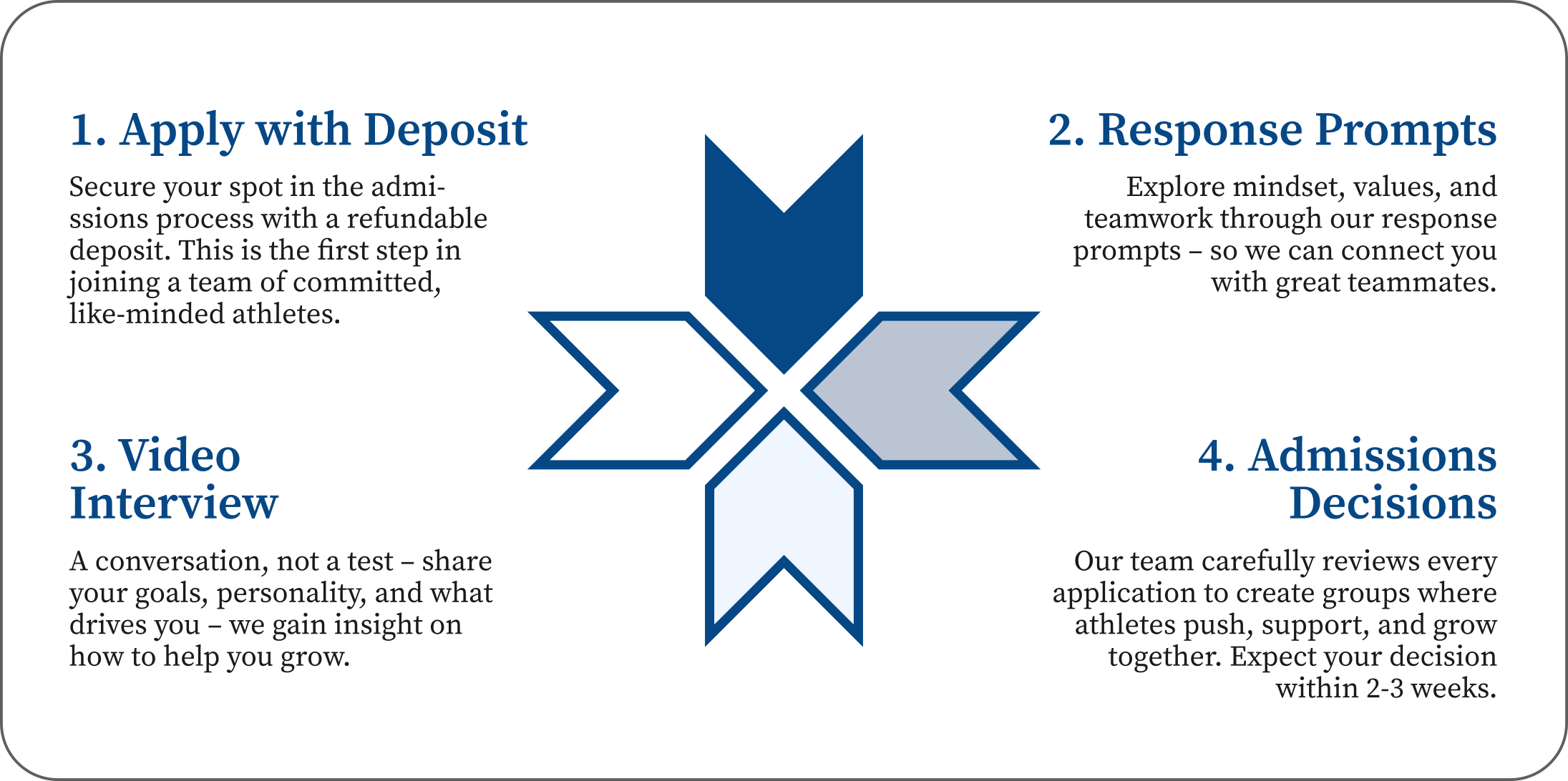
Admissions to our four week camp is a thoughtful process given the intensity of the experience.
First: you should aspire to improve your perspective and reflection as an athlete through running.
Second: you need the desire to independently integrate new ideas into your training to enhance physical and mental performance.
Finally: you seek to improve on the execution of your current training through strength and fitness.
Step 1: Initial Application
Submit your registration and pay the $995 deposit; we will accept the deposit to process your application and hold your place. If you are not offered a place, the full deposit is refundable.
Step 2: Video Response Prompts
Sparks uses video response prompts to get a genuine sense of who you are as an athlete. Keep your response natural and conversational. We're excited to hear your authentic voice and learn what drives you in your sport.
This program informs athletes' approach to running performance by enabling the self awareness to guide independent development. Athletes should seek a deeper relationship with running, possess a drive to learn and improve on all aspects of performance, and have an adventurous spirit.
The application contains these response prompts:
- Tell us a story about a team (yours or another) that stands out to you and why it means something to you.
- Tell us about a time when you had to choose between what was right for you personally and what was right for your team. What did you do?
- How would you like to grow as an athlete and why?
- Why do you want to attend a Sparks camp? Also, what specifically draws you to this program?
- What running injuries have occurred in your running career?
- Please provide your average training volume (minutes or miles) and if available, a link to your performance bio (milesplit/athletic.net account) as well as your strava account.
The prompts will be submitted on your Sparks user dashboard and are due within 14 days of initial application.
Step 3: Zoom Interview
You will schedule your interview from your Sparks user dashboard after you submit your written application. During the interview we will talk about the program, your written application, and how the opportunity aligns with your experience, values, and goals.
Step 4: Decision
Upon acceptance full payment is due by March 1. Full payment is due within 14 days for applications received after March 1.
Admissions occurs on a rolling basis. Timeline for decisions is within a week of the interview; if your timeline is shorter, we can work with you. Written applications must be submitted within 14 days of initial application, and interviews must be scheduled within 30 days of initial application.
Included in Camp Fee
- Lodging and Meals
- Camp Gear
- Coaching & Equipment
- 1:3 Staff to Athlete Ratio
- Pre-Camp Training Program
Not Included in Camp Fee
- Personal Gear
- Airfare to and from camp
- Trip Protection (strongly recommended) - Learn More
Photo Gallery
What goes into a Sparks Camp?
You get more out of a Sparks camp because we put more into a Sparks camp*
*These numbers are an approximation across all of our camps.
†Housing includes meeting and activity space for the camp during the day as well.
FAQ
Are there any additional costs beyond the camp fee?
The camp fee covers programming, coaching, accommodations, meals, ground transportation (where necessary) within designated windows, and all scheduled activities. See the itinerary for the complete list of what's included.
Parents are responsible for costs outside the standard program—medical services if your athlete gets sick or injured, travel booked outside our arrival/departure windows, or optional activities we haven't scheduled. If something comes up that requires additional expense, we'll contact you to discuss it before moving forward.
How can I prepare to get the most out of camp?
At Sparks, we train approach and mindset. So, you need to consider how you'd like to improve in those regards to get the most out of camp.
After the admissions process is complete but prior to camp, campers are asked to do some journaling on their approach to performance and their goals for camp.
After we complete the arrival portion of our first, campers entry-interview with camp staff on their goals such that everyone is on the same page as per impact for camp.
On the physiological side, we expect to be able to run the splits in your milesplit profile when you show up. That said, camp is about challenging yourself to take greater control of your relationship with performance - and doing so may enable you to perform beyond those splits at camp.
How do I know this is going to make me a better runner?
We believe the answer to this question resides in whether you believe an improved approach and mindset towards running and performance in general is going to make you a better runner.
We provide world-class quality facilities, staff, food, venues, and structure to enable you to explore how you pursue running performance from an informed and well-resourced perspective. Our admissions process is geared to admit thoughtful, emotionally mature athletes who have the ability to utilize those qualities in growing their awareness of performance.
Once you possess a greater awareness of your performance, what you choose to do with it will determine your improvement.
What level of experience is necessary for this program?
We band athletes into smaller groups by ability per their applications.
Ability levels in the cohort as a whole will differ - but that is why we maintain a low staff to student ratio. What matters is not your ability relative to the others in the group, but rather your desire to accurately evaluate your performance and plan to improve.
As a result, while this camp requires a higher level of maturity and thoughtfulness.
Do you offer scholarships or discounts?
Our prices increase as spots fill. The earlier you register, the better the price you’ll get. We also offer travel insurance that provides "cancel for any reason" coverage until 2 days prior to camp.
Regarding Scholarships:
Please see this link to our NCAA Compliance webpage.
Tell me more about admissions - how selective is it?
Our admissions process is one of the most thoughtful in the running camp industry and we evaluate each athlete on a case by case basis.
While we look speed and experience, we are also very interested in your motivation and passion for running. At our camps, the drive to improve leads to increased maturity and thoughtfulness - which leads to performance.
We also consider your ability to live, train, and support others in a community committed to utilizing challenge for personal growth. Sparks camps are unlike traditional training camps in that progress in self-awareness per your relationship with performance is as important as acute technical progress. Ideal candidates will complete the program with gains in both self-awareness and corresponding ability to improve long after camp ends.
Switzerland is designed for athletes who seek to better define their relationship with performance. You do not have to be a high performer relative to others, but you should be interested in how you might define peak performance for yourself. To be clear: we are not a performance "boot camp" whereby students are pushed beyond themselves so much as an opportunity for students to unlock the mechanisms that contribute to performance within themselves in a community committed to doing the same in a thoughtful, intelligent manner.
We welcome your questions either via phone or in the chat box in the right hand corner.
What differentiates Sparks camps and this program specifically?
When asked to perform, many athletes ask themselves why they're there in the first place. While we seek to help them answer that question, that also plays into a defining greater self-awareness.
Our mission is to challenge young adults to grow courageously as people - and as athletes. To support that mission, we're the only teen sport travel adventure camp with a full-time staff that has academic and professional backgrounds in experiential education - program design is thoughtfully crafted and executed as a result. We also have a summer operations staff (many are returners that teach during the school year) who buy into the idea of personal growth at camp not just for campers - but for themselves as well.
The overall result of these ingredients is a culture sincerely committed to the power of sport as a personally transformative experience built on vulnerability, thoughtfulness, responsibility, and initiative. These qualities along with our values of growth, kaizen, and endurance dictate the culture our camp community forms around. Our focus is on utilizing sport to create the self-awareness necessary to master one's relationship with performance.
Switzerland is a perfect venue insofar as beauty, logistics, safety, and ability to provide a high-end experience for runners. We know the venue having run rowing camps there for a number of years.
How big is the program?
Sparks multi-week cohorts are typically between 12 and 20 athletes. Coaching and operations staff ratios are set at 1:6, making overall staff to student ratio 1:3 - however, sometimes it is even lower.
Of chief importance to us is the quality of our cohorts - which we believe is a product of admissions, staffing, and group size to facilitate activities (eg. bands of runners at different speeds) as well as friendships that last long after camp ends.
We seek the highest international-quality level in coaching staff and our senior operations staff is made up of runners turned educators with a number of years of prior experience in our camp system; many hold graduate degrees in education.
What can you tell me about housing and supervision at camp?
Campers lodge in a backpackers immediately adjacent to the lake and take meals across the street at a rowing club with a private dock that be used for recovery.
At Sparks camps, we have two staffs: a coaching staff and an operations staff. Our operations staff is responsible for the experiential education and pastoral care at camp. In Switzerland, we seek a 1:3 overall staff to student ratio.
Given the selectivity of our admissions process, we experience relatively few behavioral issues given the emphasis we put on maturity, mental preparation, and engagement of the camp's mission. The Program Director lives amongst the student athletes, and has oversight 24 hours a day.
Tell me about safety at Sparks

We employ safety and risk management practices from the adventure education industry, where some risk is inherent but must be quantified insofar as educational value. These practices are initially employed in program design and we work hard to train operations staff to seek to maintain an awareness of specific risks at all times. We retain a risk management advisor and an MD on call during the summer. No outdoors programming can guarantee safety, however professional management of risk is key to the art of providing consistently excellent experiential education programming.
How do you handle travel to/from the camp?
Groups arrive and depart out of Zürich International. We seek to help families connect who would like their students to travel together and Swiss Air flies nonstop from United hub locations.
Families fill out a travel form that enables our staff to make sure your camper arrives and departs camp safely. Our Program Director (already on the ground in Switzerland as students depart) tracks student travel into Zürich, where they are picked up from the airport and transported together by train to Lucerne. Our regional directors are also on standby during travel days to handle any issue that may arise.
In the case you will arrive in Switzerland as a family and drop your camper off, we will meet at the Lucerne train station.
The journey itself is part of the experience and we design travel to our camps to invite athletes to take a personal journey with sport at its center.
If you have questions, we're happy to answer them in the box in the lower right side, or you can schedule a call with us.
I have questions before I apply. Is it possible to speak with someone?
Certainly - we completely understand your need to connect about this commitment!
We just ask you schedule a call with us (click here) given we're a very small office.
Where are camp forms found?
Camp forms are issued at least six weeks prior to camp on our site via your dashboard.
What is the cancellation/refund policy?
Camp purchases are fully refundable minus transaction fees until March 1 for summer camps.
- We strongly recommend you purchase travel protection with cancel for any reason coverage.
- We offer these plans from Travel Insured International during the check-out process for our four and five day camps and during final balance payment for deposit-based multi-week camps.
- Learn more about travel protection here
- If you withdraw after the above dates, there are no refunds for any reason whatsoever (including, but not limited to: voluntary withdraw, illness or injury, summer school, security concerns or other reasons).
- If your camper leaves camp after it starts, there are no refunds for any reason whatsoever, including but not limited to: voluntary withdrawal, illness or injury, dismissal by Sparks (due to discipline, behavior, lack of fitness or motivation, etc.) security concerns, or any other reason. Any costs incurred by Sparks as a result of an early departure are the sole responsibility of the parents.
- In the unlikely case a camp does not proceed, we'll work to notify you by March 1. You'll be offered a different program or a refund. In some cases, we may extend the 'go, no-go' date. We recommend buying your flight after March 1 or later, if we advise.