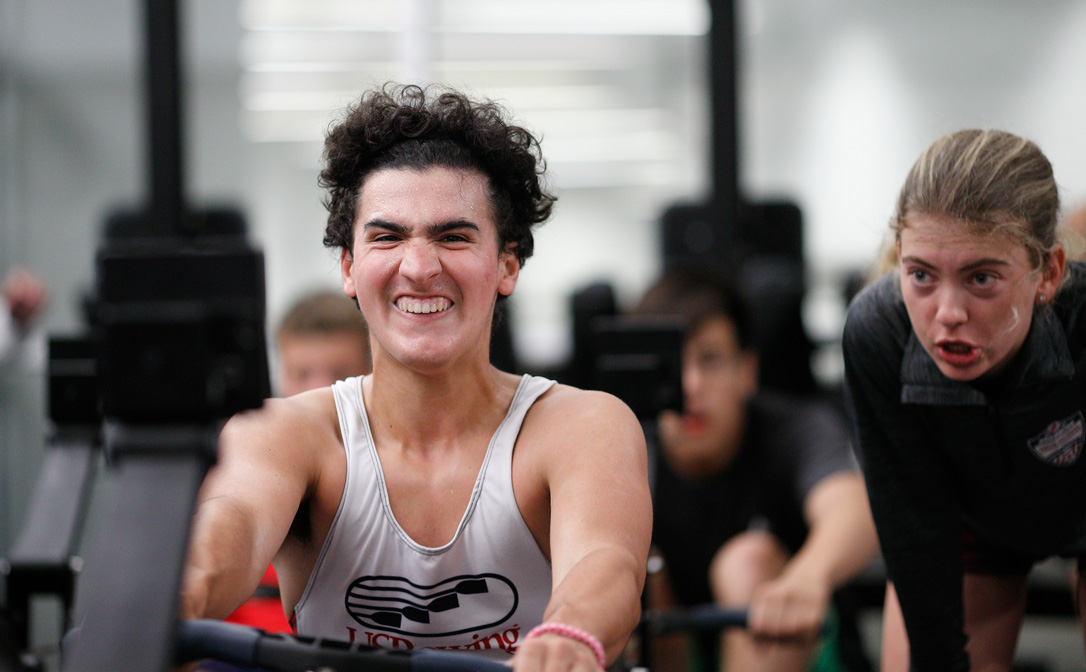
The 2K erg test is the standardized test of college rowing recruiting. Like the SAT, it opens or closes doors — but it doesn't, on its own, decide who gets in. Understanding what erg scores actually mean at different program levels, for different genders and weight classes, is essential for any family navigating the recruiting process. And yet most of the information available online is either outdated, oversimplified, or published by organizations with a financial interest in making the process seem more opaque than it is.
This guide provides current benchmarks by program tier, explains how coaches actually use erg scores in their evaluations, and addresses the questions families ask most often — including the ones that the number-obsessed corners of the internet tend to get wrong.
How Coaches Actually Use Erg Scores
Before looking at any numbers, it's worth understanding the role the erg score plays in the recruiting evaluation. It is not, despite what many families assume, the most important factor.
Rowing recruiting operates on a two-tiered evaluation system. The first tier — primary selection — is objective: 2K erg score and academics. These are the initial filters. Below a certain erg threshold for a given program level, the conversation doesn't start. Below a certain academic threshold, it doesn't matter what the erg score is.
The second tier — secondary selection — is subjective: character, maturity, presentation during the recruiting process, rowing experience, coachability, and the likelihood that the athlete will honor a four-year commitment. This is where coaches differentiate between athletes whose erg scores and grades are similar. How an athlete communicates with a coach during the process is itself being evaluated. The recruit who can articulate what they're working on, who demonstrates self-awareness about their development, and who engages thoughtfully with questions about the program and the school is demonstrating exactly the qualities coaches need in order to justify an admissions slot.
Harvard Men's Lightweight Rowing — one of the few programs that publishes detailed recruiting criteria — lists its priorities in this order: academic performance, extracurriculars, coaches' endorsement, on-water performance, and erg standards. The erg score is listed last. Not because it doesn't matter — it absolutely does as a threshold — but because once the threshold is cleared, everything else determines who actually gets recruited.
This is why erg scores alone won't get your kid recruited. They are necessary but not sufficient at every competitive program level.
Men's Heavyweight Benchmarks by Program Tier
Men's openweight rowing has the most data and the most competitive standards. These numbers represent current benchmarks based on program sources, recruiting outcomes, and counseling experience across Ivy League, Big Ten, and NESCAC programs. The ranges reflect the difference between "minimum to get a coach's attention" and "competitive for a roster spot."
Top-tier programs (Cal, Washington, Harvard, Yale, Princeton, Brown heavyweight): Recruiting athletes pulling sub-6:15, with top incoming recruits increasingly in the 6:05–6:12 range. The minimum threshold to begin a conversation is approximately 6:20. Coaches at this level are recruiting athletes who are typically 6'3" or taller and 195+ pounds, though exceptional erg scores or on-water ability can offset shorter stature. A decade ago, 6:30 opened the door at these programs. Today the threshold has moved to 6:20, and the competitive standard has moved with it.
Strong varsity programs (Wisconsin, Navy, Syracuse, Penn, Notre Dame, Virginia, Michigan, Ohio State): Recruiting 2K scores range from the 6:10s to mid-6:20s. The minimum consideration threshold is approximately 6:25–6:30. Height preference is 6'1"+, weight 190+.
Competitive varsity / Dad Vail level (Colgate, Drexel, Hobart, Temple, Lehigh, Bucknell, GWU): Competitive recruiting 2K scores range from mid-6:20s to 6:40. Minimum consideration around 6:35–6:40. Height preference is 6'0"+.
Lower D1 and competitive club programs (smaller varsity programs, competitive ACRA teams): Recruiting 2K scores in the 6:30s to 6:40s. Scholarship-granting programs generally want 6:40 or faster for athletic aid consideration.
A critical point: these tiers don't map cleanly to NCAA divisions. Some D3 programs recruit faster athletes than lower-tier D1 teams. The division label indicates institutional governance, not athletic competitiveness. This is the development-versus-management spectrum in action — programs fall along a continuum from "coach develops athletes" (walk-ons encouraged, broader experience base) to "coach manages semi-professional athletes" (high independence expected, walk-ons can't keep up). Understanding where a program sits on that spectrum tells you more about the recruiting environment than the division designation alone.
Men's Lightweight Standards
Men's lightweight rowing has fewer than 15 programs fielding competitive eights. The weight limit is strict: 160 pounds maximum per individual, 155-pound boat average. Programs are concentrated in the Ivy League and at a few other selective institutions.
Harvard Lightweight publishes the most specific recruiting criteria in the country: 2K sub-6:30, 6K sub-21:00, max watts 800+, alongside SAT 700+ per section or ACT 32+. These are thresholds for consideration — the floor, not the ceiling.
At top Ivy lightweight programs, competitive recruiting 2K times cluster around the low 6:20s for incoming recruits. A realistic recruiting profile at this level is approximately 6'0", 155 pounds, with a 2K in the low 6:20s. Some online resources claim lightweight men need sub-6:15 — this is misleading. The fastest varsity collegiate lightweights pull in the 6:17–6:24 range, meaning 6:15 approaches the top of collegiate varsity performance, not a typical recruiting standard. Confusing the ceiling with the floor leads families to set unrealistic targets or dismiss viable programs.
At second-tier lightweight programs, sub-6:35 to sub-6:40 is competitive.
Women's Openweight Benchmarks
Women's rowing occupies a unique position in college athletics. As an NCAA Championship sport with up to 20 full scholarships per D1 team, it offers more scholarship opportunity than almost any other women's sport. Roughly 89 D1 programs compete, many with rosters of 40+ athletes. This creates a wider range of recruiting standards than any other category.
Top D1 programs (Texas, Stanford, Cal, Virginia, Michigan, Wisconsin, Ohio State, Ivy League): Competitive recruiting 2K times in the low 7:20s and under, with sub-7:15 generating strong interest from the top 20–30 programs. Height preference is 5'10"+.
Strong D1 / top D3 programs: Competitive recruiting 2K times in the mid-7:20s to 7:30. Height preference is 5'9"+.
Mid-tier D1 / D2 programs: Competitive 2K times range from 7:30 to 7:50. D2 programs — roughly 15 of them, all women's — offer up to 20 scholarships with generally less competitive recruiting pools, making them the most accessible path to athletic aid.
Lower D3 / club programs: Competitive 2K under 7:55. Walk-on culture is especially strong in women's rowing, where roster sizes and Title IX incentives mean programs actively recruit novice athletes during freshman orientation.
Women's lightweight programs are rare — approximately seven teams compete, including Radcliffe (Harvard), Princeton, Stanford, and Wisconsin. Weight limit is 130 pounds. Top programs seek sub-7:35.
D3 Is Not What Most Families Expect
The assumption that D3 means "less competitive" leads many families astray. Top D3 programs in the NESCAC, NEWMAC, Centennial, and UAA conferences field athletes who would be competitive at mid-tier D1 programs, and the academic selectivity of these schools adds another layer.
For men's D3, the middle 50% of recruited athletes pull approximately 6:35. At competitive NESCAC programs, the recruiting range is 6:25–6:35 with a minimum around 6:40–6:45. Mid-tier D3 programs recruit in the 6:35–6:50 range.
For women's D3, the middle 50% is approximately 7:40. Competitive NESCAC programs recruit in the 7:25–7:35 range with a minimum around 7:40. Mid-tier D3 programs recruit in the 7:40–7:55 range.
D3 and Ivy League schools do not offer athletic scholarships — only need-based financial aid. A Princeton rower pulling 7:15 receives no athletic scholarship money.
The Benchmarks at a Glance
| Category | Gets You Noticed | Competitive for a Spot | Top Recruits |
|---|---|---|---|
| Men's D1 HW — Top Tier | Sub-6:20 | Sub-6:15 | Sub-6:10 |
| Men's D1 HW — Strong | Sub-6:30 | Sub-6:25 | Sub-6:15 |
| Men's D1 HW — Mid-Tier | Sub-6:40 | Sub-6:35 | Sub-6:25 |
| Men's D1 LW — Top | Sub-6:30 | Low 6:20s | Sub-6:20 |
| Men's D3 — Top (NESCAC) | Sub-6:40 | Sub-6:35 | Sub-6:25 |
| Men's D3 — Mid-Tier | Sub-6:50 | Sub-6:45 | Sub-6:35 |
| Women's D1 OW — Top Tier | Sub-7:25 | Sub-7:20 | Sub-7:10 |
| Women's D1 OW — Strong | Sub-7:35 | Sub-7:30 | Sub-7:20 |
| Women's D2 | Sub-7:50 | Sub-7:35 | Sub-7:25 |
| Women's D3 — Top (NESCAC) | Sub-7:45 | Sub-7:35 | Sub-7:25 |
| Women's D3 — Mid-Tier | Sub-8:00 | Sub-7:50 | Sub-7:40 |