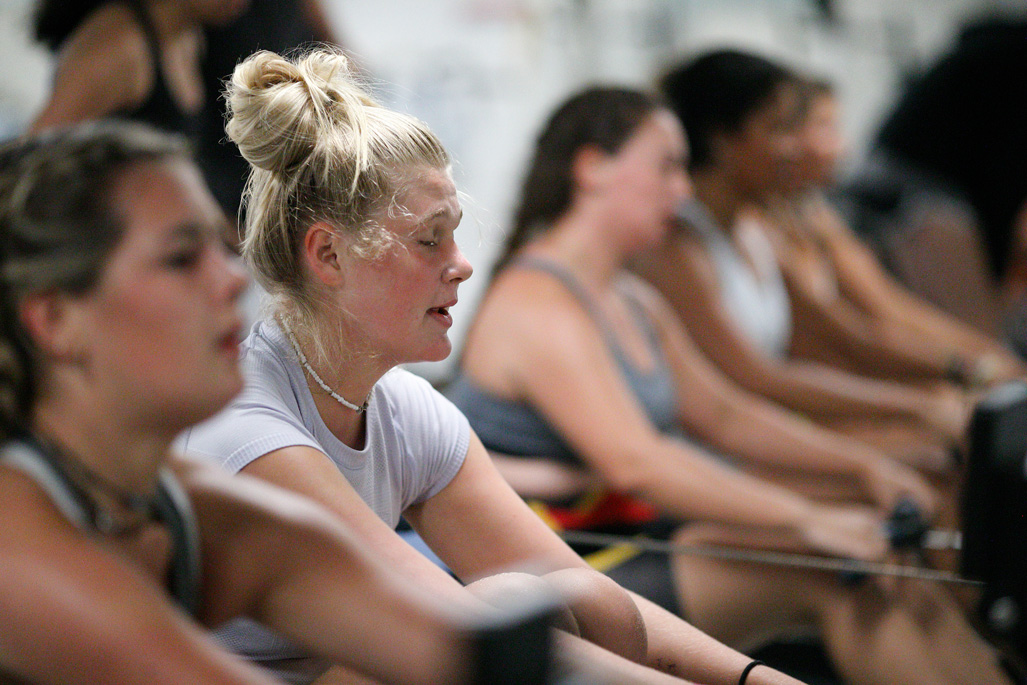
Breathing in rowing is not intuitive. The body position at the catch — compressed forward, knees to chest, trunk folded — restricts lung volume at exactly the moment the muscles demand the most oxygen. Unlike running or cycling, where the body is relatively upright and the respiratory system operates without mechanical constraint, rowing forces the athlete to coordinate breathing with a stroke cycle that alternately compresses and opens the chest. Getting this coordination right is one of the simplest ways to row more efficiently. Getting it wrong costs energy, creates tension, and limits how hard you can sustain effort over distance.
What is the correct breathing pattern for rowing?
The standard pattern is exhale on the drive and inhale on the recovery. This works because it coordinates the respiratory muscles with the rowing muscles. During the drive, the abdominal muscles engage to transfer power from the legs through the trunk to the handle. That engagement naturally compresses the lungs — exhaling with the drive works with this compression rather than fighting it. On the recovery, the trunk angle opens, the ribcage expands, and the lungs can fill freely.
There is an active discussion among coaches about whether to exhale or inhale on the drive. Some athletes and coaches prefer inhaling on the drive, arguing that expanding the chest stabilizes the trunk. The physiological evidence favors exhaling on the drive — the abdominal brace required for power transfer is stronger with an exhale — but the most important thing is consistency. An athlete who has trained successfully with the opposite pattern should not change mid-season. If you're starting from scratch, exhale on the drive.
How does breathing change at different stroke rates?
This is the question most breathing guides skip, and it matters more than the basic pattern. The coordination between breathing and stroke rate shifts as the rate increases, and athletes who don't adjust end up gasping or holding their breath — both of which degrade performance.
At rate 18–22 (steady state), most rowers take two full breaths per stroke. The recovery is long enough to fit a complete exhale-inhale cycle on both the drive and the recovery. Breathing should be deep and unhurried. This is the rate where breathing discipline is easiest to practice and where athletes should focus on exhaling completely — residual air in the lungs reduces the volume of the next inhale, which gradually starves the working muscles of oxygen over a long piece.
At rate 24–28 (threshold work), the transition zone begins. Some athletes stay comfortable with two breaths per stroke; others find they need to shift to one. Experiment in training — not on test day. The indicator is whether you can maintain full, relaxed exhales. If your breathing starts feeling rushed or shallow at two breaths per stroke, move to one.
At rate 30–34 (race pace), one breath per stroke is standard. Exhale hard on the drive, quick inhale on the recovery. The exhale is the priority — a strong, complete exhale clears carbon dioxide and triggers a reflexive, automatic inhale. Athletes who focus on inhaling tend to take shallow, tense breaths. Athletes who focus on exhaling breathe more effectively with less effort.
At rate 36+ (sprint), don't try to control the pattern. Breathing becomes rapid and shallow, and the body manages it reflexively. The conscious task at sprint rate is maintaining technique, not managing breathing. Trust the respiratory system — it has been doing this longer than you have.
Why do rowers get out of breath so quickly?
Rowing imposes a respiratory challenge that most other sports do not. Research by Professor Alison McConnell at Brunel University has documented that the inspiratory muscles — the muscles that expand the lungs — fatigue significantly during a 2000-meter race. Her studies found a 12–20% decline in inspiratory muscle strength after a maximal 2K effort. This means the muscles responsible for breathing are literally tiring out, competing for blood flow with the legs, back, and arms that are also working at maximum capacity.
For context: four-time Olympic gold medalist Matthew Pinsent recorded a lung capacity of 8.25 liters — roughly 30% above the average for a man his size. This is partly genetic and partly a training adaptation developed over decades of rowing. Junior athletes will not have this capacity. But the respiratory muscles respond to training just like any other muscle group. McConnell's research on Inspiratory Muscle Training — using devices that add resistance to breathing — showed that rowers who trained their respiratory muscles improved their 2K performance by up to 2.2%. That is a marginal gain, but it is one that requires no additional training time and no change to the rowing program.
More practically relevant for most athletes: the sensation of being "out of breath" during a race piece is often caused by incomplete exhales accumulating over dozens of strokes, progressively reducing the effective lung volume. The fix is not breathing faster — it is exhaling more completely. This is why coaches who cue "breathe" during a hard piece are usually less helpful than coaches who cue "exhale." The exhale is the active, controllable part of breathing. The inhale follows automatically.
How should you breathe during a 2K erg test?
A 2K test has three breathing phases, each with a different challenge:
The start (first 15–20 strokes): Breathing will feel easy. The oxygen debt hasn't accumulated yet. Focus on establishing your stroke-to-breath rhythm — one strong exhale per stroke on the drive. Don't hyperventilate at the start; it doesn't help and it disrupts your stroke rhythm. The work here is discipline, not effort.
The body (strokes 20 through approximately 180): This is where breathing discipline pays its dividend. Maintain one breath per stroke. When the pain increases in the third 500 meters, the temptation is to breathe faster — shorter, shallower, more panicked. Resist this. Maintain the rhythm. Focus on the exhale. A complete exhale on the drive triggers a better inhale on the recovery than any amount of gasping. If you feel yourself losing the pattern, use a verbal cue on each exhale: "out" on the drive, or count strokes in sets of ten.
The sprint (last 200–250 meters): Breathing control will diminish, and that is normal. Your inspiratory muscles are fatigued. Trying to force deep breaths at this point wastes energy that should go to the legs. Focus on exhaling with each stroke and let the inhale happen. The respiratory system is impaired but still functional — don't fight it, work with it.
Can you train your breathing for rowing?
Yes, in two ways. The first is structured breathing practice during steady-state erg sessions: deliberately focusing on complete exhales, counting breaths per stroke, and experimenting with breathing patterns at different rates. This costs no additional training time — it simply makes existing sessions more productive by adding a layer of awareness.
The second is Inspiratory Muscle Training, which involves breathing against resistance using a handheld device for five minutes, twice a day. The research supports a modest performance benefit, and the time cost is minimal. It is not a substitute for rowing training. It is a supplement — relevant for athletes who have already optimized their technique, their training structure, and their race execution, and are looking for the next marginal gain.
More broadly, breathing is one of the most accessible self-coaching tools available. An athlete who can notice "I'm breathing too fast for this stroke rate — I need to slow my exhale and let the recovery do its job" is practicing real-time self-regulation. That awareness transfers to every training session and every race. It requires no equipment, no coach standing behind you, and no special talent. It requires only the habit of paying attention — which is, in the end, what makes every other aspect of rowing faster.